
Destinations populaires
Destinations populaires
Assistance
© 2026 Yaalo.Tous droits réservés
sales@yaalo.com
| Entreprise
Orlando, FL


06 Apr 2026
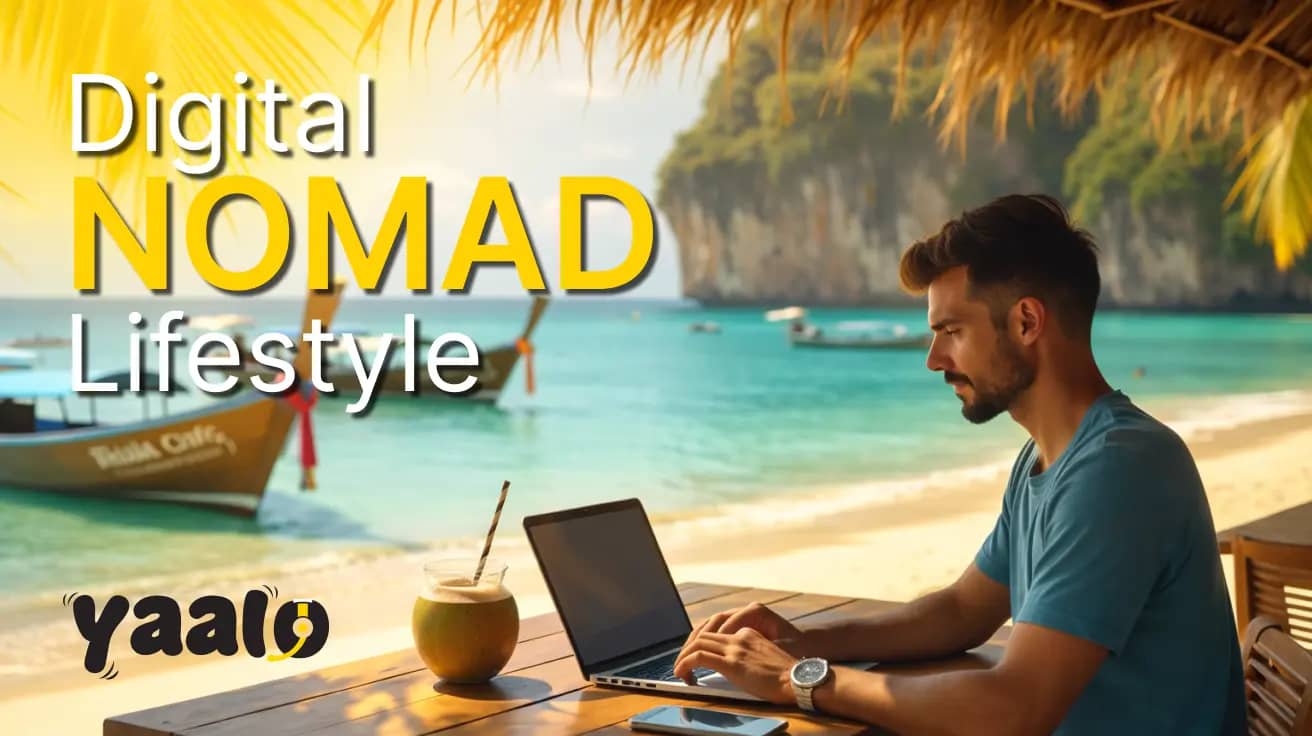
The digital nomad lifestyle is the best example of freedom. You can work from anywhere, travel more, and not have to stick to a 9-to-5 schedule. But that's how it looks from the outside. In real life, living as a digital nomad is very different.
People often take digital nomad setup as a dream come true. There are many factors that they are not aware of. The biggest one is the loneliness factor. Although the benefits of this lifestyle are amazing, only achieved with consistency and focus.
Another concept of slowmading helps digital nomads to achieve work-life balance. They master the art of slow travel pace and mental stability.
To avoid all the trouble, modern digital nomads change their schedules to include coworking spaces, coliving spaces, and global nomad communities.
This blog will tell you how digital nomads work, make routines, deal with relationships, and stay mentally healthy while living in different countries. Don't miss anything if you are running for your dream of freedom.
The assumption that having more fun, like vacation, is not true. There are many more things adding up to your life. You have to manage routines, deadlines, time zones, and 24/7 internet connectivity to keep the flow going.
Many crack them out; others keep struggling. The first two weeks seem quite delightful and passionate. But then come missed calls, unstable Wi-Fi, and late-night meetings. To avoid these interruptions, many professionals use a best hotspot for streaming to ensure their meetings never drop.
So experienced nomads treat their day less like a holiday and more like a portable workday. One that simply happens to unfold in different countries.
But still, recent digital nomad statistics and trends tell us that over 18 million Americans now identify as digital nomads.
A digital nomad's daily life includes working from home, having flexible hours, and managing time zones. They focus on deep work, online availability, and taking short trips around the area to keep things interesting while maintaining their productivity.
A common rhythm often includes:
For many digital nomads, the hardest part of the job is keeping up with time zone differences. A software engineer sitting in Thailand and working with a team in New York. It's like managing 12 hours difference.
If there is no plan for scheduling, your health is at risk due to disturbed sleep cycles. The solution for this is the deep work technique.
Deep work simply involves setting aside uninterrupted hours for tasks that demand full attention, like writing, coding, strategy work, or design. During these periods, notifications are turned off, and meetings are avoided.
Once the important work is done, the rest of the day becomes easier to manage. Many remote professionals eventually build a rhythm like this:
This structure reduces context switching and promotes a healthier work-life balance, even with geographically dispersed teams.
Constant flights, unfamiliar apartments, unstable internet, and new routines as per the timezone, thats old now. The digital nomads' growth and engagement gave rise to a new term: Slowmading.
A technique that turns out to be the crack of saving you from a hectic, stressful life that will end your freedom. Slowmading simply means staying in one place longer.
Like you, move on to Colorado, USA, a new place. Now you have to be there for at least 6 to 7 months. If not 6 to 7 months, do not shift. Understand this as creating multiple benefits for yourself to achieve real freedom:
Slowmading digital Nomad lifestyle is a technique for enjoying your freedom. It's not a myth or false claim. There are approximately 18-19 million registered digital nomads, according to the MBO Partners Digital Nomad Report (2025). Since the USA unemployment rate has gone down to 4.3% in 2026, more and more digital nomads are looking for a USA Visa.
Slowmading, especially in North America, is the best digital nomad lifestyle in 2026. Also, fast local Wi-Fi speeds of 200 Mbps to 350 Mbps are available. But that may cost you upto $80/mo. Only 12 devices are allowed, and it's on your premises. So, what to do when exploring and for social communication?
eSIM is the solution you can count on. Find as low as $5.15 for 1Gb of data for 3 days on high-speed internet in North America, with T-Mobile as your carrier. The Instagram and X are totally updated when exploring.
So, you know the technique of Slomading to handle your personal end while being a digital nomad. It's all a matter of consistency.
Now, the next worry after 3 months of Slowmading is the fear of being alone while having Freedom. Because you are so busy making millions, and loneliness git you suddenly. Leveraging modern travel tech allows nomads to stay productive while moving between these social hubs.
The solution expands your Social Dynamics to improve your lifestyle. Go for your interest and make contact with new people. The good news is that the global nomad ecosystem has changed significantly over the last 10 years.
Join thriving communities of location-independent workers hooking in coworking spaces, coliving homes, meetups, and networking events made just for remote workers.
The nomad’s community and social connections are two of the most important factors in the long-lasting businesses we all know.
Ten years ago, digital nomads meets are rare. But in 2026, multiple gigantic organizational events are happening worldwide. The remote work lifestyle boosts global economies. These collaborations and joint ventures introduce Coliving spaces and Digital Nomad Hubs.
Countries like Portugal, Turkey, Japan, Mexico City, Thailand, and Indonesia contributed more to the Digital Nomad scene. They provide fast internet speeds, eSIM support, affordable living costs and advanced coworking spaces, gathering attention.
One of the biggest developments in recent years has been the rise of coliving spaces for remote workers.
Coliving communities combine accommodation, coworking space, and social activities under one roof. Residents typically stay for several weeks or months, creating a temporary community of entrepreneurs, freelancers, developers, designers, and remote employees.
Daily life in these spaces often includes:
The issue of instant social integration was put to an end with Coworking solutions. People here like you and do what you do. The confidence chills up, and many nomads get a career boost!
Even with the Slowmading technique, relationships, especiall long term, are not possible.
Maybe the affection wins sometimes, but work-focused professional lads should not try this.
Dating could be a solution, and there are plenty of online platforms to try. You can talk to new people and respond in your own style. Coworking space communities understand the culture.
Some nomads eventually meet partners who share the same lifestyle, turning travel into a shared long-term journey rather than a solo experience.
Others prioritize friendships and professional networks over romantic relationships, focusing on career growth and global mobility.
The key difference compared to traditional dating is flexibility. When your life is location-independent, relationships often evolve around shared travel plans, remote work schedules, and lifestyle compatibility rather than geography alone.
Despite the freedom it offers, the digital nomad lifestyle can occasionally feel isolating. Constant movement, changing time zones, and temporary friendships can make it harder to build the kind of long-term social stability many people are used to.
This is especially true for new nomads who travel quickly from city to city without building routines or deeper connections.
Over time, experienced travelers learn that community is something you actively build, not something that automatically appears.
Many long-term nomads rely on a few strategies to protect their mental well-being while living on the road:
This way of doing things is part of a broader change happening in the nomad world. Many remote workers are choosing slow travel over always seeking new places to visit. They stay in one place long enough to make friends, build routines, and make business connections.
Researchers studying remote work view social infrastructure, such as coworking spaces, nomad communities, and peer networks are crucial for long-term living and working in diverse locations.
Being able to work from anywhere sounds freeing. But it can be harder than many first-time digital nomads think to stay physically and mentally healthy while moving around all the time.
There is a real problem behind the Instagram photos of laptops on beaches: making routines that last in an unstable environment.
Recent studies show that the freedom to work from home also brings new health risks. For instance, 74% of remote and hybrid workers say that burnout is a big problem, and 44% say that their mental health has gotten worse since they started working from home instead of in an office.
The numbers tell a similar story for digital nomads in particular. 41% say they feel alone when they travel, and 38% say they have burned out from working too much or not being able to tell the difference between work and travel.
These trends show an important truth about the way people live:
Long-term nomads eventually figure out that having good health habits, being fit, and being mentally strong are all important parts of a career that can be done from anywhere.
Digital nomads have a hard time maintaining their health habits because they are constantly moving between different places.
It's easy to stick to routines when your life is stable. Living as a nomad does the opposite. Every few weeks, you change the way your kitchen is set up. The kinds of groceries you can buy differ from country to country. Your sleep schedule may even change as you move from one time zone to another.
Digital nomads usually stay in each place for about 5 to 7 weeks, which makes it hard to keep up with gym memberships, cooking routines, or regular workout schedules.
Because of this, many remote workers end up with habits that are bad for their health:
A lot of experienced digital nomads have flexible health habits, like:
These activities show a growing trend toward travel that involves movement, with physical activity integrated into exploring a place rather than a separate gym session.
Learning about nutrition is also a journey. Each country has its own way of eating, its own foods, and its own way of cooking. This can make travel more interesting, but it also takes work to stay hydrated and eat well.
Many long-term travellers learn a simple rule over time: Routine is better than motivation.
Even small habits, like walking in the morning, eating at the same time every day, or working out at the same time every week, can help keep things stable when you travel a lot. Just as you monitor your health, you must manage your phone's performance; for instance, check is your eSIM draining battery to avoid extra stress during long travel days.
One of the biggest risks for digital nomads is burnout. Not all of the time is the problem overwork. A lot of the time, it's because there are no boundaries.
Remote workers often work in places where their work, travel, and personal lives overlap. An office is in a café. An Airbnb living room becomes a meeting place. A day of sightseeing turns into late-night calls with clients in different time zones.
Studies show that 58% of people who work from home struggle to fully disconnect from work, and 60% say their work-life boundaries are blurry, which makes stress worse in the long run.
Digital nomads may feel even more pressure. Many freelancers, founders, and remote workers feel they have to be available to clients or teams at all times.
Up to 77% of digital nomads say they have experienced burnout at least once. This is mostly because of the pressure to be productive and the "always-on" culture of remote work.
Over time, this leads to a cycle of travel fatigue and cognitive overload:
Experienced nomads eventually learn that protecting their mental energy is just as important as managing their time for sustainability.
Long-term remote workers often use the following strategies: setting fixed working hours even when their schedules are flexible.
Scheduling "offline exploration days" while travelling, limiting the number of productivity tools and notifications, making sure you get enough sleep no matter what time zone you're in, and getting help from coworking communities or therapy platforms are all good ways to stay productive.
No doubt, having a Digital Nomad Lifestyle in 2026 is all about having freedom. There are challenges to face, but one should come out of their comfort zone to coupe them. With scheduled & well-managed routines, you stay goal-oriented. The art of being socially connected, following the Slowmading technique, and practicing health-focused routines provides you with freedom. That's how you are living the perfect Digital Nomad lifestyle!
Nina Alexandra ●
06 Apr 2026
Best Digital Nomad Lifestyle: Slowmading Burnout & Community
Digital Nomads